In the early weeks of April, you may notice a beautiful drapery of purple flowers cascading from many different trees across all of Moore County. These fragrant blooms attract a variety of pollinators and are often seen hanging on trees along roadsides, in front and back yards, and even climbing over small shrubs. These flowers come from a plant called wisteria. There are different varieties of wisteria, but the one that blooms en masse around the first week of April is the invasive Wisteria sinensis, or Chinese wisteria. Its fragrant flowers hang in large, drooping clusters(racemes) that typically range from 12 to 18 inches long.
Chinese Wisteria in Moore County
(Updated: July 16, 2026, 12:44 p.m.)

Inflorescence of Wisteria sinensis: Christian Flores

Chinese Wisteria Beginning to Climb a Leyland Cypress: Christian Flores
In Moore County, wisteria can be found climbing loblolly and longleaf pines, crape myrtles, magnolias, and many other trees. While it may not pose an immediate threat, over time it will kill the tree through strangulation, water, root, light, and air competition.

Chinese Wisteria Shrouding a Large Magnolia: Christian Flores
Chinese wisteria was introduced to the U.S. in the early 1800s as an ornamental plant. Since then, it has been widely planted and spread throughout much of North Carolina and the surrounding Southeastern United States. However, due to its unique seed pods, it escapes cultivation quite easily. The plant spreads by rooting stolons and seeds, which eject from their pods, making wisteria an autochore, a plant that disperses seeds without external agents.
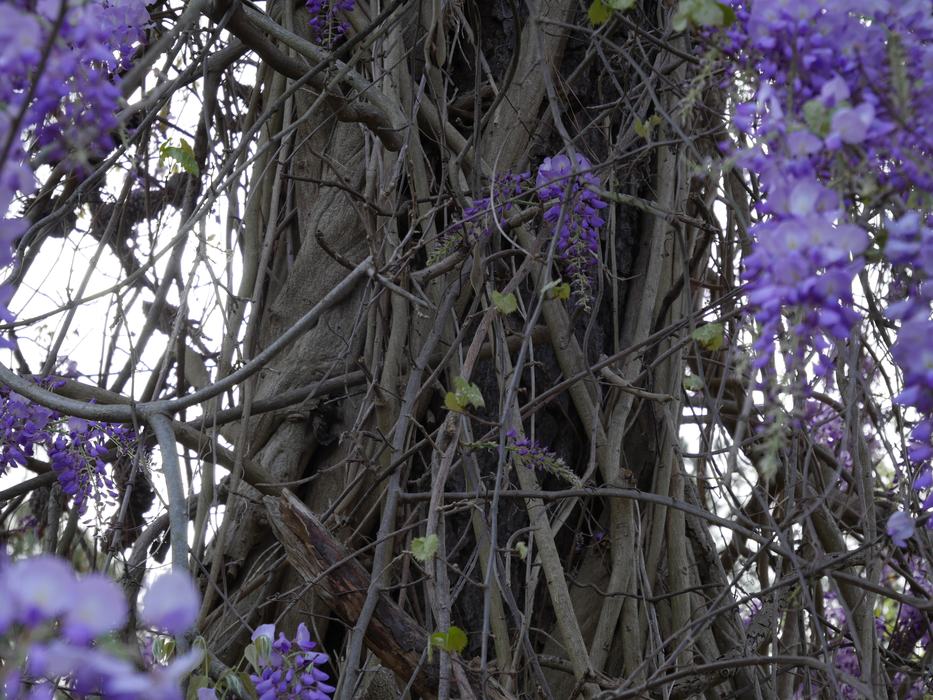
Chinese Wisteria vines around a Loblolly Pine: Christian Flores
Over time, wisteria will develop a hardy, woody vine and can climb up to 25 feet or more, depending on the support it finds. Wisteria vines typically twist counterclockwise around trees, shrubs, and structures, gradually tightening their grip and eventually snuffing out their hosts. With no natural pests or diseases to curb their growth, these vines can create thick mats that block out sunlight and overwhelm native plants.
Wisteria belongs to the Fabaceae family, which means it absorbs nitrogen from the atmosphere, converting it into a usable form of nutrients. This trait is partly to blame for why wisteria commonly thrives in nutrient-poor environments such as roadsides, ditches, and the edges of forests.
Like many invasive species, wisteria can be challenging to manage. Complete eradication typically requires either removing the entire root system or applying herbicide to freshly cut stumps. Foliar herbicides may also work, but they can pose a risk to surrounding plants and wildlife, so they are not recommended. If you encounter a wisteria vine wrapping around a tree, cutting it at the base and allowing the top to die back will relieve stress on the tree. While regular pruning can help control its spread, it won’t eradicate the vine. After cutting wisteria at ground level, the above-ground portions will die off, but the vine may regrow from the roots. Repeated cutting at the base multiple times a year may weaken the plant, but it is unlikely to fully eradicate it. For effective control, you will likely need to treat the freshly cut stump with an herbicide to prevent regrowth.
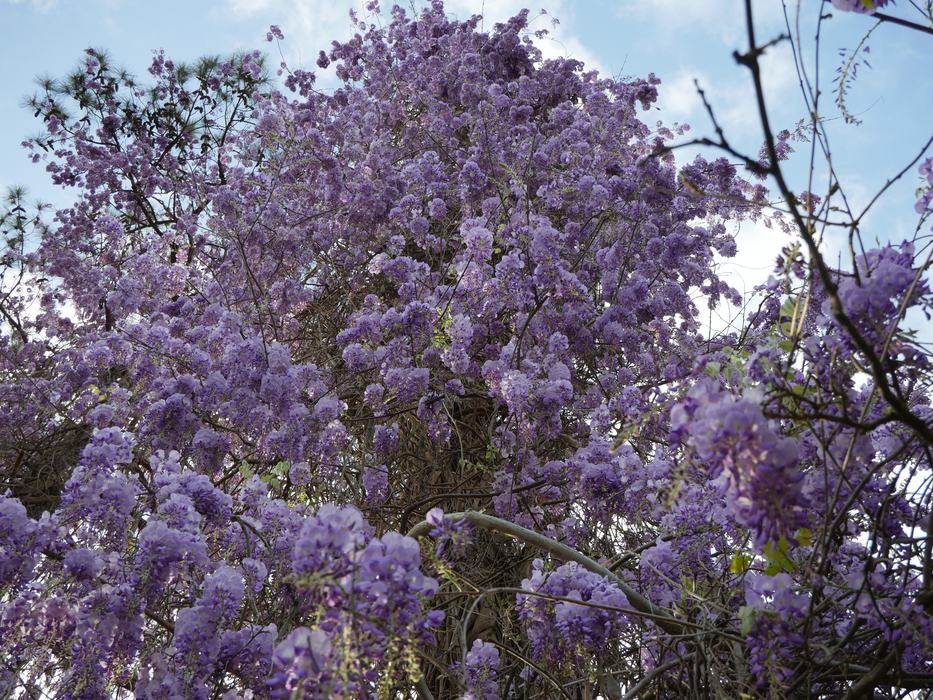
Chinese Wisteria Growing in Abundance Among Two Loblolly Pines: Christian Flores
While the immaculate display Chinese wisteria puts on can be a striking addition to any landscape, it’s important to recognize the potential harm this invasive species can cause to our native ecosystems. Alternatively, American wisteria, or Wisteria frutescens, offers a less aggressive choice, growing at about a third the rate of its relative, requiring minimal pruning and carrying no risk of becoming invasive. It can be trained to climb a trellis, fence, or other structures, and can even be pruned into a shrub form. Its flower clusters bloom later in the season and are noticeably shorter, typically less than 10 centimeters long, compared to the much longer clusters produced by its invasive relative.
By understanding the growth habits of invasive species and taking the necessary steps to manage their spread, we can protect our native trees and plants here in North Carolina.
Join our mailing list!
Enter your email address to receive updates.
Written By
